By Felicia Wong, Fund Director, Robert Carr Fund
Recently, I attended the World Health Summit (WHS) (11-13 Oct 2026). This three-day gathering had a clear ambition: to better harness innovation and international cooperation to make health systems more resilient to current crises and prevent future health emergencies.
But global health’s resilience challenge is not a shortage of innovation. Many of the solutions to the world’s most pressing health risks already exist. When it comes to global health security, what matters is that these solutions reach the people who most need them.
Here are my key takeaways from the summit.
1. In an age of interconnected health threats, building resilience means bringing everyone to the table
At the launch of The Lancet Commission on 21st Century Global Threats to Health, 17 “catastrophic threats to health and human survival” were identified, including climate change, pandemics, income inequality, and the collapse of development assistance for health.
Yet among the gloom, there was a message of hope. “…the future is not predetermined,” said Dr. Natalia Kanem, Commission Co-Chair and former UNFPA Executive Director. “Each of us can take action to change the course of the future on these 17 health threats.”
The Commission proposed three approaches: building readiness through resilient health systems (rather than ad hoc crisis responses), investing in innovation, and tracking threats through continuous monitoring and accountability. The best way to do these things is to bring everyone to the table, including the communities most impacted by multiple crises.
Such communities embody resilience, not only when crises hit but at all times. This is how communities most affected by HIV have survived decades of stigma, discrimination and marginalisation.
When systems exclude them, they find ways to keep going. When those same systems fail, they forge ahead. This was true when the HIV pandemic started, and it is true now. This is why the theme of RCF’s 2025 Annual Report is ‘When systems fail, communities forge ahead’.
This was the year HIV funding cuts really hit. As RCF civil society representatives reflect in the report:
Once again, community-led networks became the infrastructure that held… We are systems of protection, accountability, solidarity, and collective action. When crises emerge, communities do not have the option of leaving. We remain. We organise. We respond.
WHS sessions frequently referenced the need to ensure communities participate in shaping responses. In a session on pandemic preparedness, Dr. Javid Abdelmoneim, MSF’s International President, said: “You need to ensure that communities are included in the response design, as well as research protocols and everything else.”
Community leaders have decades of expertise in responding to health threats. Yet these voices were often absent from WHS’ major panels or only included in limited ways. This was a missed opportunity.
2. A more locally driven health architecture is needed, and that requires shifting power to communities
Health responses that leave some people behind create vulnerability for everyone. This means health systems will only become resilient when they are truly inclusive. And that requires sharing power and resources with the organisations and networks closest to overlooked communities.
WHS speakers consistently argued for a more locally driven health architecture, of the need to strengthen local ecosystems and intermediaries, of the benefits of supporting local leadership and local ownership, and of building partnerships that recognise communities as experts and equal partners.
The need to move beyond tokenistic youth engagement came through strongly in health governance discussions. In CIFF, PMNCH and Fondation Botnar’s roundtable, Maria Antonieta Alcalde Castro, Director General of IPPF, described how she began health advocacy as a teenager, which taught her that presence is not the same as power.
Representation is one thing, but having the confidence and agency to speak to your legislator or parliamentarian is essential. This is what moves marginalised communities from having a presence to having power. Our communities have opened some of those doors. But we need to remove the door entirely, so there are no barriers to marginalised communities being fully part of decision-making.
In 2025, 14 of our partners held formal seats in planning processes where decisions about services for marginalised communities were made. Their presence helped establish the first PrEP pilot for prisoners in Moldova, improved underserved communities’ access to health clinics in Zimbabwe, and widened young people’s access to HIV services in Nigeria, Malawi and Zambia. Partners also influenced change outside formal seats.
In Benin, a partner network spent 2025 training local community organisations to negotiate directly with the Ministry of Health by showing how stigma in health facilities is a barrier to HIV testing and treatment. Our partner contributed to this result alongside UNAIDS, UNDP and national community networks.
These examples show the strength communities can bring to a health system. Which is why genuine partnership and power-sharing is essential.
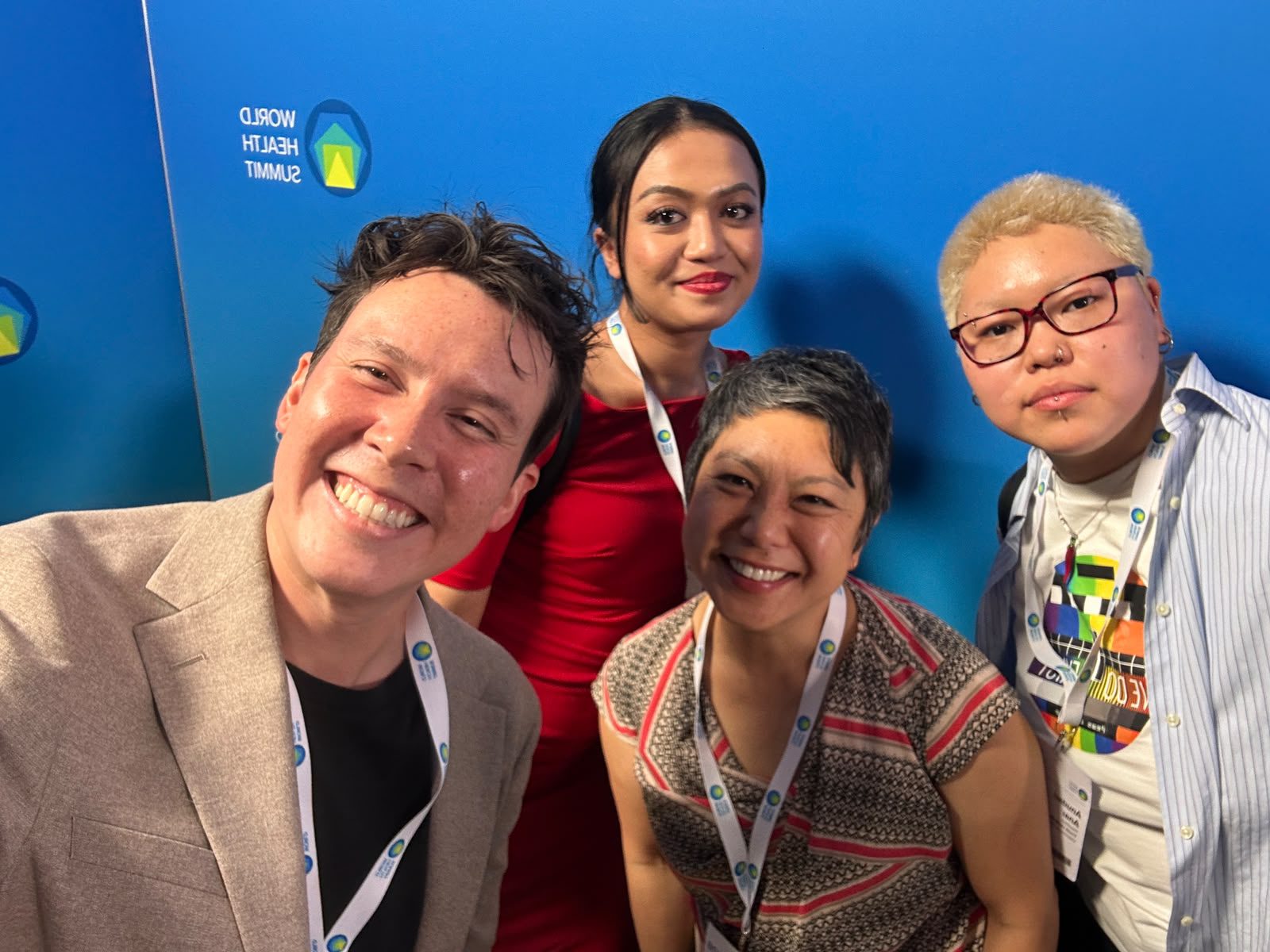
Felicia Wong with some grantee partners at WHS 2026
3. Accountability matters
A recurring question across sessions was how to move global health recommendations from evidence and policy papers to real-world implementation.
At the Lancet Commission’s launch, Dr. Izukanji Sikazwe, head of HIV at the Global Fund, highlighted the need to move the report from something that sits in ministry drawers to “actual action”. For this to happen she said: “Communities need to stand up and be counted. Hold governments accountable…”
Communities are critical to accountability. They are best placed to know whether commitments are translating into measurable change.
Discussions repeatedly underlined how trust is a key ingredient here. At its most basic, this means institutions and governments doing what they commit to, and communities being able to sound the alarm if they don’t and see action taken to rectify things. Accountability mechanisms are how this happens.
In a side event, GFAN, Alliance for Public Health and Action against AIDS Germany showcased the Together We Save Lives, an important accountability campaign which shines a light on unfulfilled Global Fund commitments. In closing remarks, Professor Michel Kazatchkine, former Global Fund director and former Chair of the Robert Carr Fund International Steering Committee, urged people to reject ‘them and us’ thinking, arguing that it is not governments or the Global Fund leadership that is the enemy but HIV, TB and malaria.
In 2025, 57% of our partners engaged directly with the Global Fund, and by doing so connected community priorities with funding, governance and service delivery. Across the Caribbean, Nepal, Georgia, Kenya, Mozambique, Zimbabwe, Nigeria, Mongolia, Indonesia, India and Mali, partners served as grant recipients, CCM members, board or advisory-body representatives, technical assistance providers and frontline community actors.
In 2025, their presence helped secure harm reduction commodities, protect local CSO funding, influence national HIV strategies, expand youth and key-population representation, and enable pregnant women with HIV to access peer mentoring.
The Global Fund, UNAIDS and the WHO are now all entering leadership transitions (the WHO’s was discussed at this session), while initiatives like UN80 and the Accra Reset are pushing for significant powershifts across the entire international cooperation spectrum.
Discussing the prospects of a new WHO Director-General, UN Secretary-General and changes in other political leadership, Dr. Richard Horton, editor-in-chief of The Lancet, described this as “a unique moment to work in partnership to rewrite the way we hold those leaders accountable for addressing the greatest dangers facing us”.
We now have the opportunity to redefine the importance of communities in the global health architecture and at regional and national levels. But some panellists warned that this opportunity will be lost if leadership transitions focus on organisational continuity rather than inclusive governance. The consequences of this would be far reaching: global health is an ecosystem, and a shift in one part will have impacts across the whole structure.
4. There is a disconnect between commitments to community-led responses and actual funding
A summit letter from WHO’s Director General highlighted how official development assistance for health fell by 40% in 2025.
In 2025, three in four RCF partners experienced funding losses. They described the impact as immediate and structural, causing service disruption, staff losses and commodity stock-outs.
At WHS calls were made for governments to create dedicated budget lines for community responses and for flexible funding to be prioritised. Funding community-led networks also makes financial sense as they are pivotal in ensuring marginalised communities get the prevention and treatment services they need. And as Global Fund Portfolio Manager Olga Avdeeva noted, strengthened prevention and treatment leads to fewer infections and more manageable future costs.
RCF is one of the few global HIV response funders to provide core, flexible, multi-year support to community-led networks. This enables networks to retain experienced staff, strengthen governance, have sound finances, and retain engagement in decision-making spaces. And it puts them in the best position to adapt when crises hit.
The decisions being made now will determine how resilient health systems become. For these decisions to be as impactful as possible, community-led networks must have the staffing, stability and staying power to be in the mix. If that happens, everyone will benefit.